
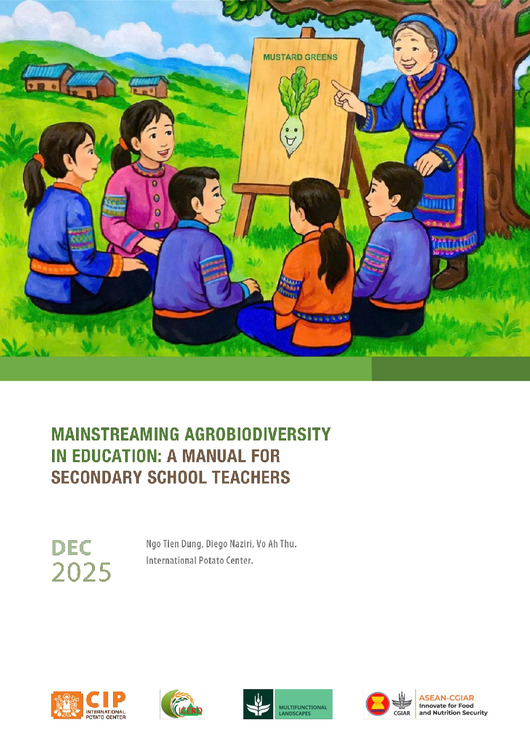
 Manual
Agrobiodiversity includes all the organisms directly or indirectly used for food and agriculture – including crops, livestock, fisheries, wild species, and genetic resources (genes, varieties, breeds), as well as species that are not used by humans but are still integral to agro-ecosystems. Agrobiodiversity is the result of natural selection processes and the careful selection and inventive developments of farmers, herders, and fishers over millennia. Agrobiodiversity is a vital sub-set of biodiversity. Many people’s food and livelihood security depend on the sustained management of various biological resources that are important for food and agriculture. There is increasing recognition that agriculture is a key driver of biodiversity loss. The spread of industrial agriculture has seen vibrant native ecosystems replaced by large-scale monocultures based on a handful of highyielding seeds and breeds, and intensive use of chemical inputs. These uniform farming systems undermine agrobiodiversity, wild biodiversity, and the diversity of our diets. Moreover, they are leaving food systems highly vulnerable to diseases and climate shocks, forcing farmers and communities off their land, and accelerating the loss of biodiversity-rich farming systems and associated knowledge. Expansion of agricultural production to new land drives deforestation, which in turn results in loss of natural habitats and the species these host. Overexploitation of land resources, including through the overuse of agrochemicals, leads to degradation of land and water bodies, and consequently to the loss of precious biodiversity resources such as beneficial insects – including pollinators – that help sustaining agroecosystems and agricultural production. Farmers play a crucial role in conserving and managing agrobiodiversity. In fact, the diversity of species that support agricultural production systems has been carefully managed and shaped by farming communities, over the course of the history of humankind. For example, species were selected that could adapt easily to the local environmental conditions, or that had desired characteristics, such as specific taste or higher yields. Farmers act as custodians of the Earth’s agrobiodiversity resources and play a big part in preserving traditional plant and animal varieties, as well as traditional local knowledge on agricultural and food-related practices. Women farmers, in particular, play a central role in agrobiodiversity conservation. It is often women who select and save seeds, tend to home gardens where landrace crop varieties and indigenous animal breeds are often preserved, and maintain local knowledge on the medicinal properties of wild plants. Farmers do not have control of all the processes that relate, directly or indirectly, to food production and supply – for example, agricultural policies, incentives, or market functioning. However, they can shape the ways in which food is sourced by shifting to or expanding the use of production practices that are less or not harmful to natural ecosystems and biodiversity. This manual is designed to guide and support secondary school teachers in introducing students to the concept of agrobiodiversity and its relationship with various aspects of farm production and management across major agro-ecosystems – namely farming, forest, soil, and inland aquatic systems. By raising awareness among youth about the importance and multiple benefits of conserving local agrobiodiversity and traditional knowledge, the manual aims to foster more sustainable practices and behaviors at both household and community levels. While this knowledge may benefit those students who continue in agriculture in the future, its impact can be immediate: students can share what they learn with their family members, potentially influencing current farming practices towards more sustainable and resilient approaches. In this way, the benefits extend beyond the classroom, thus supporting improved nutrition, livelihoods, and environmental health for both people and the planet. This manual was developed with support from the CGIAR Initiative “Nature+: Nature-positive solutions for shifting agri-food systems to more resilient and sustainable pathways”, the CGIAR “Multifunctional Landscapes 12 Science Program”, and the “ASEAN-CGIAR Innovate for Food and Nutrition Security Program.” These initiatives aim at integrating agri-food production systems with innovative nature-positive solutions to cope with climate change and the depletion of natural resources, and have a strong focus on the conservation and sustainable use of agrobiodiversity. As part of this effort, four secondary schools in two mountainous districts in northwestern Vietnam (Mai Son in Son La province and Sa Pa in Lao Cai Province) have been engaged since 2022 to integrate agrobiodiversity and agroecology into their curricula. Activities were identified collaboratively with school deans and teachers and included the following components: (i) exemplary lectures for students in grades 6 to 9, delivered by experienced consultants; (ii) a Training of Trainers (ToT) program to introduce teachers to key agrobiodiversity concepts and strengthen their facilitation skills using participatory methods; (iii) classroom lectures delivered by the trained teachers, based on the knowledge and tools acquired during the ToT; (iv) establishment of school gardens as hands-on learning platforms where teachers can conduct practical lessons; (v) a student contest focused on observing and recording agrobiodiversity using a digital app; and (vi) ongoing engagement with parents to support the development and reinforcement of students’ knowledge and skills at home. Based on these experiences, the teachers recommended developing a manual that would support them in delivering lectures and conducting practical activities with the students in a structured way. As they say, “our vision is that students realize that they are part of a larger natural system and are empowered to take action for their future.” It was also noted that this resource would have been instrumental to institutionalize the new topics and learning approaches, and formally embed them in their educational activities. This manual was conceived in response to this request. It was also agreed that the manual should have been co-designed with the teachers to ensure its appropriateness and enhance the likelihood of adoption by other schools in Vietnam. Therefore, two co-design workshops were held in 2024 with the participation of the school teachers and representatives of the Lao Cai Department of Education and Training (DoET), the Lao Cai Center for Vocational and Continuing Education, the International Potato Center (CIP), and the Center for Initiatives on Community Empowerment and Rural Development (ICERD) – a domestic civil society organization. The purpose of the workshops was to identify the training needs of teachers, and the topics to be included in the curriculum and in the manual. This manual is the result of this process. It is important to note that, in consultation with the teachers, it was agreed to strike a balance between making it as suitable as possible to the specific needs of the target schools and designing in a way to ensure that its use is not limited to Vietnam only