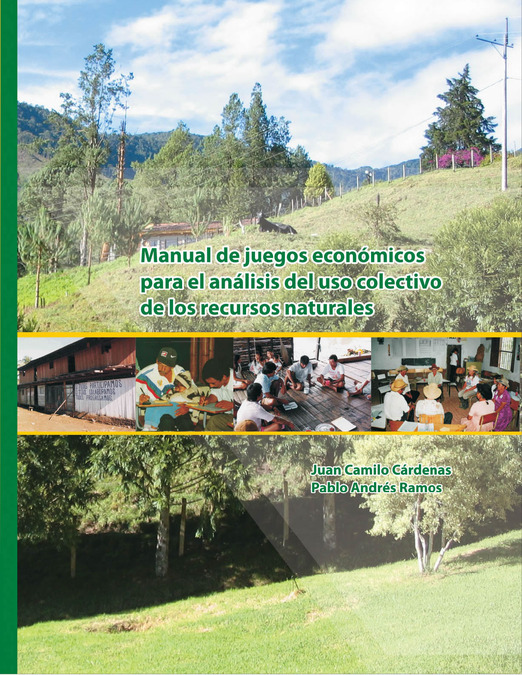
This handbook is designed for field practitioners, policy designers, analysts, and academia, interested in the analysis of the use and management of natural resources, local ecosystems and local public goods in general. The handbook resulted from more than seven years of experience conducting experiments in the field with thousands of villagers of Colombia who depend on cooperation and the use of local resources. Using tools from experimental economics, the handbook offers a set of games that can be applied in the field and the classroom for the study of human behavior and its interactions with institutions and social norms. The games included are: a competitive market with and without externalities, public goods provision game, common-pool resource game, watershed game, prisoners’ dilemma, trust game, and Coase bargaining game. The handbook includes all the materials needed to run each of the games and hints on how to analyze the data, using examples from our own experience applying these in rural areas of Colombia. These games, designed for everyone to use and apply with any group of students, villagers or neighbors, offer detailed data about the possibilities and limitations for solving problems of cooperation, the tragedy of the commons, the provision of public goods, and the social preferences of individuals including altruism, reciprocity, trust, inequality aversion among others. These are factors that play a crucial role in cases such as the use of common-pool resources and public goods (watersheds, irrigation systems, fisheries, forests). These games can be later used to discuss the results in a participatory manner with the participants to discuss the solutions to the social dilemmas involved in the management of local ecosystems and the provision of local public goods.
This Notice explains what personal data CapSha collects, why it is
processed, how it is protected, and the choices available to you.
Latest revision: August 13, 2026
1Introduction
CapSha is committed to processing data fairly, with integrity,
responsibility, security, and transparency. We process personal data in accordance with CapSha’s Data Protection Policy (DPP) and related internal procedures. Where applicable, we also take into consideration relevant legal, regulatory, and contractual obligations.
This means we handle information in line with CapSha’s own Data
Protection Policy (DPP) and not under any national, regional
jurisdiction. We process data only for legitimate purposes related
to the mandate of the initiative, and we apply the highest
standards to safeguard your privacy. CapSha may provide this
Notice in different formats. In situations where data is collected
offline or verbally (for instance, via phone or in person during
field projects), we will inform you of the key points of this
Notice and let you know how to access the full text for more
details. Regardless of how we collect your data, we handle it
according to the principles in this Notice.
2Scope
This Notice applies to all personal data that CapSha collects in
the below contexts. It covers the data of:
Website Users: individuals visiting CapSha
websites and users who interact with CapSha’s official social media pages.
Event Participants: individuals registering for
or attending CapSha events, conferences, webinars, workshops, or
training sessions.
Visitors to CapSha Premises: personnel and
guests entering CapSha premises, offices, or facilities.
Newsletter Subscribers: individuals subscribing
to CapSha newsletters, email updates, or mailing lists.
Platform/Database Users: individuals creating
accounts for CapSha repositories, databases, forums, or managed
online systems.
Contest or Survey Respondents: individuals
participating in contests, competitions, surveys, and
questionnaires.
Media Subjects: individuals whose images,
video, audio, or voice are captured during CapSha activities.
Project Beneficiaries: individuals whose
personal data is collected in CapSha field projects or
programmes.
Project Partners: where a partner processes
data on CapSha’s behalf under an agreement with data-processing
terms, this Notice and CapSha’s instructions apply.
This Notice also applies when CapSha obtains personal data about
individuals from third-party sources. Specific platforms may
present additional terms or privacy information. Third-party
websites linked from CapSha are governed by their own privacy
policies. This Notice concerns personal data about identifiable
individuals.
3What data we collect and how
The type of information we collect depends on your interaction
with CapSha. We only ask for information relevant and necessary
for the stated purpose. This may include your full name, title,
affiliation, postal address, email address, telephone number, and
country.
When you contact CapSha, we collect details needed to respond.
When you subscribe, we collect your email address and possibly
your name.
When you register for an event or training, we collect
information needed to manage participation.
Account information
If you create an account, we collect credentials and information
needed to establish and maintain it.
Survey or contest responses
We collect responses, submissions, feedback, and any personal data you voluntarily provide.
Media
With your consent, we may collect photographs, video, audio, or
voice and may request a Consent & Release Form.
Professional or background information
We may request professional qualifications, a CV, expertise, or
publications when relevant.
Project beneficiaries
We may collect information needed to establish eligibility,
deliver assistance, monitor a project, or obtain feedback.
Automatically collected data
Our websites and platforms may collect IP address, browser type,
operating system, referring website, pages accessed, dates and
times, cookies, and similar technical information.
Users may manage cookie preferences through their browser settings. Certain website functions may be affected if cookies are disabled.
Data from other sources
CapSha may receive data from partners or other authorized sources
and will handle it according to this Notice.
4Why we collect your data
CapSha collects and uses data only for purposes aligned with our
mandate and the service provided.
Responding to inquiries and requests.
Facilitating participation in events and activities.
Providing access to platforms and services.
Sending requested newsletters and announcements.
Delivering assistance and managing projects.
Conducting surveys, contests, and feedback
activities.
Sharing impact stories with consent.
Analysing and improving websites and services.
Other mission-related purposes disclosed at
collection.
Ensuring security of premises and systems.
CapSha processes personal data based on consent, contractual necessity, legitimate organizational interests, fulfillment of its mandate, or other grounds permitted under its Data Protection Policy.
5Who has access to your data and how we share it
Within CapSha
Access is restricted to authorized personnel who need the
information for the purposes described. Personnel and
collaborators are subject to confidentiality obligations and
access controls.
Third-party partners and service providers
CapSha may share the minimum necessary information with trusted implementing partners.
Partners receive only information necessary for their assigned
task.
Partners must handle information confidentially and securely.
CapSha does not sell, rent, or trade personal information.
6How long we keep your data
CapSha retains personal data only for as long as necessary for the
purpose for which it was collected and according to internal
retention rules.
One-time event or inquiry data may be deleted or anonymized
after follow-up is complete.
Subscriber and account information is retained while the
subscription or account remains active.
CapSha periodically reviews, securely erases, destroys, or
anonymizes data no longer required.
Data may be retained longer for compliance, auditing, archiving,
research, statistics, or protection of CapSha’s rights, with
appropriate safeguards. It will not be kept indefinitely.
7How we protect your data
CapSha uses technical, physical, and organizational measures to
prevent unauthorized access, disclosure, alteration, or
destruction.
Secure infrastructure, encryption where applicable, firewalls,
and monitoring.
Need-to-know access controls.
Training, policies, and confidentiality requirements.
Incident and data-breach response procedures.
Controls are reviewed and updated in line with CapSha rules,
industry practices, and applicable international standards.
Where appropriate, CapSha may notify affected individuals of significant data-security incidents in accordance with its internal procedures.
8Requests related to your data
Under CapSha’s DPP, you may submit requests concerning personal
data held about you.
Access: request confirmation and a copy of your
personal data.
Correction: request correction of inaccurate or
incomplete data.
Deletion: request erasure where there is no
overriding reason to retain the data.
Objection or withdrawal of consent: object to
processing or withdraw consent where applicable.
Requests may be subject to limitations under CapSha’s rules.
CapSha will respond and explain any refusal or limitation.
Personal data may be accessed or processed in multiple countries where CapSha, CGIAR centers, or authorized service providers operate. Appropriate safeguards are applied to protect personal data.
9How to submit a request or contact us
To submit a request, question, concern, or complaint about
personal data, use the CapSha Contact Support page at
Contact Us Page
and select the appropriate option. CapSha may need to verify your
identity before fulfilling certain requests. We will respond within a reasonable timeframe in accordance with our internal procedures.
10Changes to this data protection and privacy notice
CapSha may update this Notice to reflect legal requirements,
improvements in data-protection practices, or operational changes.
Significant changes may be communicated prominently. The latest
revision date appears at the top of the Notice.
11Privileges and immunities & applicable law
Nothing in this Notice shall be construed as a waiver of CapSha’s
privileges or immunities or as acceptance of the jurisdiction of
national courts. CapSha is a CGIAR initiative governed by its own
internal legal framework, including its Data Protection Policy and
related procedures, together with general principles of
international law.
Report
There was a problem reporting this post.
Block Member?
Please confirm you want to block this member.
You will no longer be able to:
See blocked member's posts
Mention this member in posts
Invite this member to groups
Add this member as a connection
Please note:
This action will also remove this member from your connections and send a report to the site admin.
Please allow a few minutes for this process to complete.

 Working Paper