
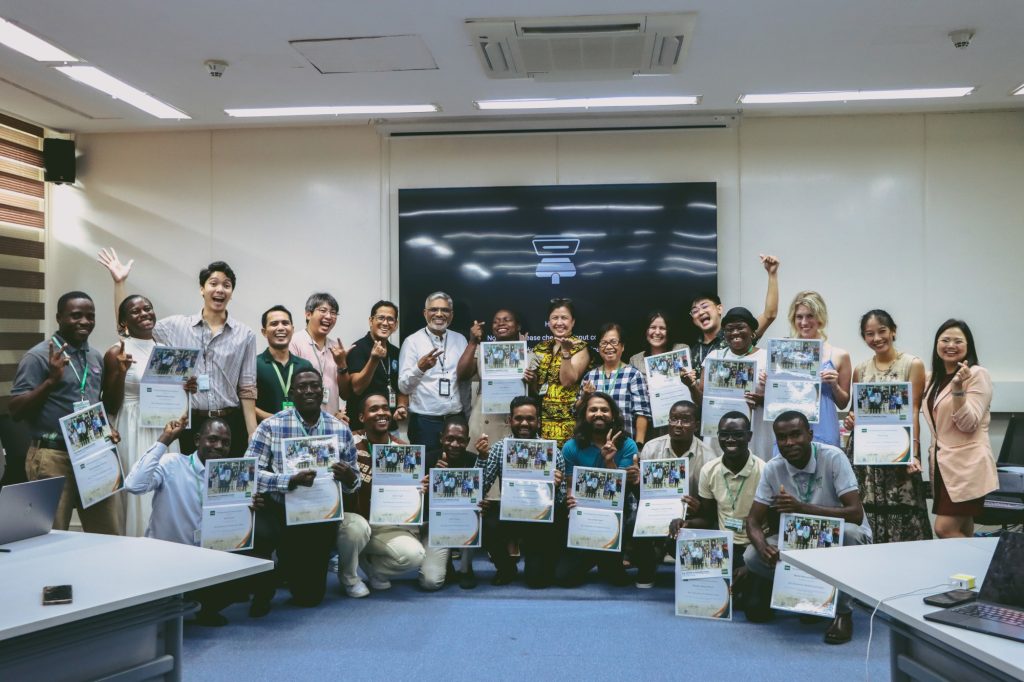
Photo Credit: IRRI Education
Ten researchers from Africa participated in the 2026 Rice: Research to Production course through support from the CGIAR Capacity Sharing Accelerator (CapSha), gaining practical exposure to different aspects of rice research, production and innovation.
The three-week course, organized by the International Rice Research Institute (IRRI), was held from 25 May to 11 June 2026 at IRRI headquarters in Los Baños, Philippines. It brought together 16 researchers, graduate students, and agricultural professionals from Africa, Asia, Latin America, and North America.
Now in its nineteenth year, the Rice: Research to Production course combines classroom instruction with laboratory exercises, field activities, institutional visits and engagement with farmers and agricultural experts.
Participants explored subjects including rice physiology, genetics and breeding, pest and disease management, postharvest systems, climate-smart agriculture, digital agriculture, agricultural policy and impact evaluation. The course was designed to help participants understand the rice value chain from scientific research through to production and its application in farming communities.
Linking research with farming realities
An important part of the course was the opportunity to engage with farmers, researchers, agricultural enterprises and other actors involved in rice production.
Participants took part in a rice-planting experience, interviewed farmers in Laguna, and visited agricultural institutions and enterprises. They also travelled to Banaue, where they learned about indigenous rice culture and traditional farming practices in the region’s rice terraces.
These activities helped connect the scientific content of the course with the practical, economic, and social realities facing farming communities.
A participating doctoral researcher described the experience as changing their understanding of the global effort required to improve food security and the relationship between scientific work and farmers’ contributions.
Supporting African researchers through CapSha
CapSha supported the participation of ten researchers from Africa in the course. The support was part of a wider collaboration with IRRI to expand access to relevant learning opportunities for African researchers and agricultural professionals.
CapSha works with CGIAR Centers, programs and partners to strengthen the capacities needed to improve food, land, and water systems. Its approach emphasizes knowledge exchange, collaborative learning, and stronger professional and institutional networks.
For the participating African researchers, the course provided access to IRRI’s technical expertise while creating opportunities to exchange knowledge and experience with colleagues from other regions.
Nartey Elizabeth Norkor, Assistant Research Scientist at Ghana’s CSIR-Crops Research Institute, said the course was practical, educational and well structured.
“This well-structured course challenges you to strive to become a better leader in the rice ecosystem,” she said.
Charles Afriyie-Debrah, Senior Research Scientist at the same institute, said the training strengthened his knowledge and practical understanding of agricultural innovation systems.
“Overall, it has improved my ability to apply research outputs to real-world agricultural challenges,” he said.
Participants also highlighted the professional relationships developed during the course. By learning and working alongside researchers from different countries and disciplines, they expanded networks that may support future knowledge exchange and collaboration.
This work is carried out with support from the CGIAR Capacity Sharing Accelerator (CapSha). We would like to thank all funders who supported this research through their contributions to the CGIAR Trust Fund: https://www.cgiar.org/funders/