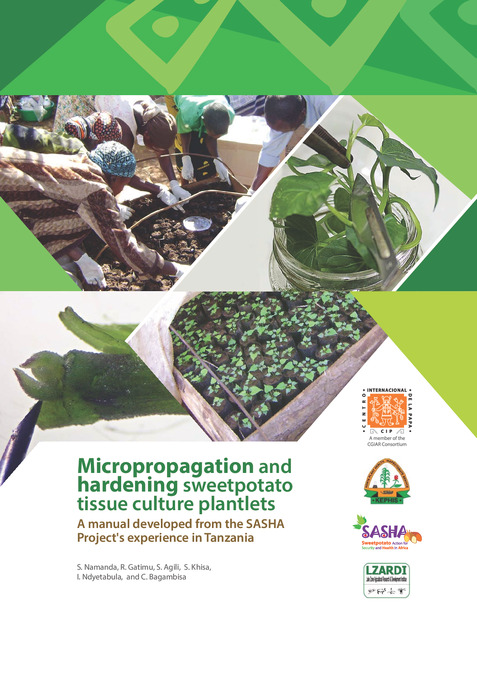
Sweetpotato is an important food and cash crop in sub-Saharan Africa (SSA), because it is tolerant to adverse growing conditions and has a short growing period. However, sweetpotato farmers in Africa have problems accessing healthy planting material. Often, they rely on sprouts from un-harvested roots left in the ground from the previous season. Such planting material may have high levels of sweetpotato virus infection, hence leading to considerable reduction in yields. Providing adequate supplies of improved quality of planting material at the right time is vital for the increased production and utilization of sweetpotato. Notably, in the Lake Zone of Tanzania, sweetpotato virus diseases exert enormous pressure on the growing crop. The use of pathogen tested tissue culture plantlets as source material is one approach to improving the quality of planting material available to farmers. Tissue culture is a promising technology, however it is costly and some critical steps are required for the successful transfer of in vitro plantlets to field conditions for further multiplication. There had been limited efforts to test the use of this method at large scale as part of a sweetpotato seed system intervention. Between 2010 and 2012 the International Potato Center (CIP) through the Sweetpotato Action for Security and Health in Africa (SASHA) project, partnered with the Lake Zone Agricultural Research and Development Institute (LZARDI), the Kenya Plant Health and Inspectorate Service (KEPHIS), Catholic Relief Services (CRS) and CRS-affiliated community development organizations to initiate an intervention for the promotion of timely dissemination of quality planting material. The intervention, popularly referred to as ‘Marando Bora’ involved the successful cross border transfer of 35,000 sweetpotato tissue culture plantlets by road from Nairobi (Kenya) to Bukoba (Tanzania), a distance of about 1,500km, and the subsequent acclimatization (or hardening)process. This manual is based on the experiences and lessons from the implementation of the SASHA Marando Bora project in Tanzania. It seeks not only to bridge the gap in information and capacity, but also to generate interest and guide similar efforts elsewhere in SSA. It shares the hands-on practices for: the initiation and mass propagation of tissue culture plantlets, transportation, hardening and field establishment. Factors that increase the survival and growth of plantlets into field plants are highlighted. This manual is intended for scientists and technicians who are responsible for the successful transfer of sweetpotato tissue culture plantlets for field multiplication and who are working in limited resource settings in SSA. The manual will also provide seed system practitioners in general, an overview of the tissue culture based procedures required for germplasm management and exchange so as to ensure that the quality of seed available to farmers is improved.
This Notice explains what personal data CapSha collects, why it is
processed, how it is protected, and the choices available to you.
Latest revision: August 13, 2026
1Introduction
CapSha is committed to processing data fairly, with integrity,
responsibility, security, and transparency. We process personal data in accordance with CapSha’s Data Protection Policy (DPP) and related internal procedures. Where applicable, we also take into consideration relevant legal, regulatory, and contractual obligations.
This means we handle information in line with CapSha’s own Data
Protection Policy (DPP) and not under any national, regional
jurisdiction. We process data only for legitimate purposes related
to the mandate of the initiative, and we apply the highest
standards to safeguard your privacy. CapSha may provide this
Notice in different formats. In situations where data is collected
offline or verbally (for instance, via phone or in person during
field projects), we will inform you of the key points of this
Notice and let you know how to access the full text for more
details. Regardless of how we collect your data, we handle it
according to the principles in this Notice.
2Scope
This Notice applies to all personal data that CapSha collects in
the below contexts. It covers the data of:
Website Users: individuals visiting CapSha
websites and users who interact with CapSha’s official social media pages.
Event Participants: individuals registering for
or attending CapSha events, conferences, webinars, workshops, or
training sessions.
Visitors to CapSha Premises: personnel and
guests entering CapSha premises, offices, or facilities.
Newsletter Subscribers: individuals subscribing
to CapSha newsletters, email updates, or mailing lists.
Platform/Database Users: individuals creating
accounts for CapSha repositories, databases, forums, or managed
online systems.
Contest or Survey Respondents: individuals
participating in contests, competitions, surveys, and
questionnaires.
Media Subjects: individuals whose images,
video, audio, or voice are captured during CapSha activities.
Project Beneficiaries: individuals whose
personal data is collected in CapSha field projects or
programmes.
Project Partners: where a partner processes
data on CapSha’s behalf under an agreement with data-processing
terms, this Notice and CapSha’s instructions apply.
This Notice also applies when CapSha obtains personal data about
individuals from third-party sources. Specific platforms may
present additional terms or privacy information. Third-party
websites linked from CapSha are governed by their own privacy
policies. This Notice concerns personal data about identifiable
individuals.
3What data we collect and how
The type of information we collect depends on your interaction
with CapSha. We only ask for information relevant and necessary
for the stated purpose. This may include your full name, title,
affiliation, postal address, email address, telephone number, and
country.
When you contact CapSha, we collect details needed to respond.
When you subscribe, we collect your email address and possibly
your name.
When you register for an event or training, we collect
information needed to manage participation.
Account information
If you create an account, we collect credentials and information
needed to establish and maintain it.
Survey or contest responses
We collect responses, submissions, feedback, and any personal data you voluntarily provide.
Media
With your consent, we may collect photographs, video, audio, or
voice and may request a Consent & Release Form.
Professional or background information
We may request professional qualifications, a CV, expertise, or
publications when relevant.
Project beneficiaries
We may collect information needed to establish eligibility,
deliver assistance, monitor a project, or obtain feedback.
Automatically collected data
Our websites and platforms may collect IP address, browser type,
operating system, referring website, pages accessed, dates and
times, cookies, and similar technical information.
Users may manage cookie preferences through their browser settings. Certain website functions may be affected if cookies are disabled.
Data from other sources
CapSha may receive data from partners or other authorized sources
and will handle it according to this Notice.
4Why we collect your data
CapSha collects and uses data only for purposes aligned with our
mandate and the service provided.
Responding to inquiries and requests.
Facilitating participation in events and activities.
Providing access to platforms and services.
Sending requested newsletters and announcements.
Delivering assistance and managing projects.
Conducting surveys, contests, and feedback
activities.
Sharing impact stories with consent.
Analysing and improving websites and services.
Other mission-related purposes disclosed at
collection.
Ensuring security of premises and systems.
CapSha processes personal data based on consent, contractual necessity, legitimate organizational interests, fulfillment of its mandate, or other grounds permitted under its Data Protection Policy.
5Who has access to your data and how we share it
Within CapSha
Access is restricted to authorized personnel who need the
information for the purposes described. Personnel and
collaborators are subject to confidentiality obligations and
access controls.
Third-party partners and service providers
CapSha may share the minimum necessary information with trusted implementing partners.
Partners receive only information necessary for their assigned
task.
Partners must handle information confidentially and securely.
CapSha does not sell, rent, or trade personal information.
6How long we keep your data
CapSha retains personal data only for as long as necessary for the
purpose for which it was collected and according to internal
retention rules.
One-time event or inquiry data may be deleted or anonymized
after follow-up is complete.
Subscriber and account information is retained while the
subscription or account remains active.
CapSha periodically reviews, securely erases, destroys, or
anonymizes data no longer required.
Data may be retained longer for compliance, auditing, archiving,
research, statistics, or protection of CapSha’s rights, with
appropriate safeguards. It will not be kept indefinitely.
7How we protect your data
CapSha uses technical, physical, and organizational measures to
prevent unauthorized access, disclosure, alteration, or
destruction.
Secure infrastructure, encryption where applicable, firewalls,
and monitoring.
Need-to-know access controls.
Training, policies, and confidentiality requirements.
Incident and data-breach response procedures.
Controls are reviewed and updated in line with CapSha rules,
industry practices, and applicable international standards.
Where appropriate, CapSha may notify affected individuals of significant data-security incidents in accordance with its internal procedures.
8Requests related to your data
Under CapSha’s DPP, you may submit requests concerning personal
data held about you.
Access: request confirmation and a copy of your
personal data.
Correction: request correction of inaccurate or
incomplete data.
Deletion: request erasure where there is no
overriding reason to retain the data.
Objection or withdrawal of consent: object to
processing or withdraw consent where applicable.
Requests may be subject to limitations under CapSha’s rules.
CapSha will respond and explain any refusal or limitation.
Personal data may be accessed or processed in multiple countries where CapSha, CGIAR centers, or authorized service providers operate. Appropriate safeguards are applied to protect personal data.
9How to submit a request or contact us
To submit a request, question, concern, or complaint about
personal data, use the CapSha Contact Support page at
Contact Us Page
and select the appropriate option. CapSha may need to verify your
identity before fulfilling certain requests. We will respond within a reasonable timeframe in accordance with our internal procedures.
10Changes to this data protection and privacy notice
CapSha may update this Notice to reflect legal requirements,
improvements in data-protection practices, or operational changes.
Significant changes may be communicated prominently. The latest
revision date appears at the top of the Notice.
11Privileges and immunities & applicable law
Nothing in this Notice shall be construed as a waiver of CapSha’s
privileges or immunities or as acceptance of the jurisdiction of
national courts. CapSha is a CGIAR initiative governed by its own
internal legal framework, including its Data Protection Policy and
related procedures, together with general principles of
international law.
Report
There was a problem reporting this post.
Block Member?
Please confirm you want to block this member.
You will no longer be able to:
See blocked member's posts
Mention this member in posts
Invite this member to groups
Add this member as a connection
Please note:
This action will also remove this member from your connections and send a report to the site admin.
Please allow a few minutes for this process to complete.

 Manual